HIIT for Running Performance: Work-to-Rest Ratios, Programming by Event, and Hypoxic Training (Evidence-Based Guide)

HIIT (high-intensity interval training) is widely used to improve running performance. At the same time, it can be surprisingly easy to miss the target if your work-to-rest ratio, total volume, and weekly frequency don’t match your goal.
In this article, we’ll review the science behind HIIT and then translate it into practical programming for sprinters, middle-distance runners, and distance runners. We’ll also include a clear, evidence-based overview of hypoxic training as an optional add-on.

HIIT isn’t “the harder, the better.” The key is whether the session creates the right stimulus for your purpose.
What You’ll Learn in This Article
- What HIIT is (and how it differs from steady running and tempo/LT running)
- Key HIIT adaptations (cardiorespiratory and muscular/metabolic)
- How to choose work-to-rest ratio, sets, and weekly frequency by event (sprint, middle-distance, distance)
- When cycling HIIT makes sense vs running HIIT
- Where hypoxic training fits (and when it may not)
What Is HIIT? How It Differs From Traditional Aerobic Training
Definition
HIIT alternates high-intensity work with recovery periods. It includes formats ranging from very short repeats (<45 seconds) to longer intervals (2–4 minutes). Reviews emphasize that outcomes depend heavily on how you combine key variables such as intensity, interval duration, recovery duration, and total volume [2, 11].
Steady Running vs Tempo/LT Running vs HIIT
“Running” is not one thing—your training effect changes with pace and intensity. Here’s a practical way to compare three commonly used categories:
| Training Type | Main Goal | What Improves |
| LSD (Long Slow Distance)* | Build aerobic base | Endurance foundation and recovery capacity |
| Tempo / LT running** | Sustain faster pace for longer | Race-pace tolerance near lactate threshold |
| HIIT | Raise your upper limit | VO2max and high-intensity tolerance |
* LSD: conversational effort, roughly 60–70% of max heart rate.
** Tempo/LT: often ~80–88% of max heart rate (varies by athlete). “LT” refers to the intensity boundary where lactate begins to accumulate more rapidly—many runners describe it as “hard but sustainable,” typically for ~20–40 minutes.
VO2max is the maximum amount of oxygen your body can take in and use per minute during exercise.
Heart: how much blood it can pump
Lungs: how well oxygen gets into the blood
Muscles: how well oxygen is used to produce energy
VO2max is essentially the “upper ceiling” of this combined system.

What HIIT Can Improve
A well-known study by Helgerud and colleagues compared four training approaches: LSD, tempo/LT running, short intervals (15 s work / 15 s rest), and longer intervals (4 min work / 3 min recovery). The HIIT groups showed greater improvements in VO2max and stroke volume/cardiac output in that setting [5].
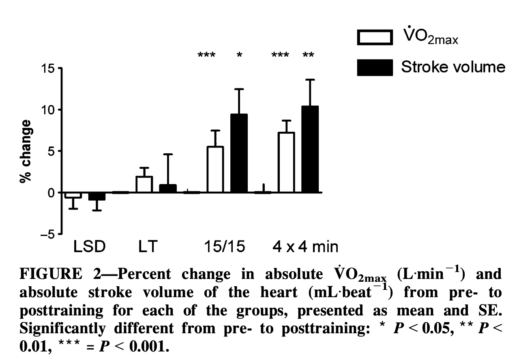
In this study, HIIT improved VO2max and cardiac output more than LSD or tempo running.
That said, it doesn’t mean LSD and tempo work are “unnecessary”—their roles are different.
HIIT Adaptations: What Changes in the Body?
Cardiorespiratory Adaptations (VO2max and central factors)
- HIIT can improve VO2max in many athletes [1, 5].
- For VO2max-focused intervals, it is commonly recommended that intensity reaches at least ~90% of VO2max during repeated bouts (often reflected by high heart rate late in the session) [2].
Muscular/Metabolic Adaptations (mitochondria and substrate use)
- Even with shorter total time, sufficiently high intensity can promote muscular metabolic adaptations [4].

Here, “metabolic adaptations” refers to changes such as increases in mitochondrial-related proteins, oxidative enzyme activity, glucose transport, and fat-oxidation capacity.
- HIIT and continuous training can drive different patterns of adaptation [7].
| Typical HIIT Adaptations | Typical Continuous-Run Adaptations |
|
Improved central factors (cardiac output), higher VO2max ceiling |
Improved peripheral factors (muscle oxidative capacity), stable long-duration metabolism |
Think of it like this:
◯ HIIT: raises your “maximum engine output”
◯ Continuous running: improves “fuel efficiency and durability”
It’s less about which is superior—and more about using each method for its role.
Even if two sessions are both called “HIIT,” changing work-to-rest ratio, intensity, total time, or weekly frequency can meaningfully change the stimulus (cardiorespiratory, metabolic, and neuromuscular stress) [11].
Programming HIIT: Work-to-Rest Ratio, Sets, and Weekly Frequency
What does the work-to-rest ratio actually change?
The work-to-rest ratio is a practical “dial” that influences three key outcomes:
- Maintaining cardiorespiratory stress (shorter rest keeps heart rate and ventilation higher)
- Maintaining speed/quality (longer rest makes it easier to preserve pace and form)
- Accumulating musculoskeletal stress (repeated high-speed work can increase tendon/muscle loading)
Reviews emphasize that HIIT is fundamentally about manipulating these programming variables to match the goal [2, 11].
Some authors describe up to nine HIIT “variables,” including: modality (running vs cycling), intensity, work duration, rest intensity (complete vs active), rest duration, number of reps, number of series, rest between series, and the intensity of that rest.
In reality, you don’t need to overcomplicate it—start with your goal, then adjust using heart rate, perceived exertion, and whether pace and technique stay consistent.
● Heart rate
Often reaches ~90% of HRmax after ~2–3 minutes, then stays elevated with fluctuations.
● Perceived exertion (RPE)
8–9/10: very hard, but you can maintain form and finish the planned volume.
● Quality check (important for runners)
If pace drops sharply or form breaks down early, consider extending rest, reducing reps, or lowering intensity.
Event-specific examples: sprint, middle-distance, distance
For sprinters (100–400 m): protect speed quality with longer recovery
- Goal: max speed, acceleration, speed endurance (high neuromuscular and anaerobic emphasis)
- Principle: shorter work bouts + longer rest to keep each rep fast
- Typical work:rest: roughly 1:5 to 1:10 (e.g., 7 s work → 35–70 s rest)
- Weekly frequency: often 1 session/week in-season, up to 2 in preparation phases (other days prioritize skill, strength, and recovery)
- Example A (max speed exposure): 6–8 s work / 45–90 s rest × 6–10 reps × 1–2 sets (4–6 min between sets)
- Example B (speed endurance (e.g., 400 m)): 20–30 s work / 2–4 min rest × 4–8 reps
Because sprint-oriented intervals rely heavily on anaerobic energy contribution and neuromuscular load, recovery selection strongly affects outcomes [11, 14].
For sprinters, the “right answer” often means protecting speed—more than simply pushing fatigue.
If your speed drops early, extending rest or reducing reps may be the smarter adjustment.
For middle-distance (800–1500 m): combine VO2 density and race-pace tolerance
- Goal: raise VO2max ceiling + tolerate fast sustained pace
- Principle: combine a dense short-repeat session and a quality-focused longer-repeat session within the week
- Weekly frequency: up to ~2 HIIT sessions/week, with tempo/steady running, technique, and strength to balance total load
- Example A (VO2 stimulus, short dense repeats): 15 s work / 15 s rest for 10–20 minutes total (you may insert 1–2 minutes of extra recovery as needed)
Very short repeats may help maintain near-VO2max intensity in some runners, especially those who have built primarily with continuous training [12]. - Example B (race-pace tolerance, protect quality): 30–60 s work / 60–120 s rest × 6–12 reps
With enough recovery, pace and form can stay higher while still generating a strong cardiorespiratory stimulus [11, 14].
Rather than choosing just one method, it often works best to select a session type based on your purpose—and rotate stimuli across the week.
For distance runners (5000 m to half marathon): raise VO2max and support LT with tempo
- Goal: improve VO2max while also pushing lactate threshold (LT) upward
- Principle: use short or long repeats for VO2 stimulus, and support “cruise ability” with tempo/LT work
- Weekly frequency: often up to ~2 HIIT sessions/week for 5k/10k-focused runners; ~1–2 for half-marathon goals (tempo and long runs typically remain a priority)
- Example A (short repeats for density): 30 s work / 30 s rest for 10–20 minutes (you may add brief extra recovery if needed)
- Example B (longer repeats near VO2): 4 min work / 3 min recovery × 4 reps (often around ~85–95% HRmax for many runners)
The 4×4 format has been associated with VO2max improvements in research and is commonly discussed as a practical prescription [5, 6].
For many distance runners, HIIT is mainly for improving VO2max.
To make race pace feel easier, tempo/LT running and long runs still matter a lot.

Tempo run: a steady effort near LT (“hard but controlled”), typically improving your ability to sustain race-like pace.
Long run: longer duration at low-to-moderate intensity (conversational), supporting aerobic base, fatigue resistance, and energy efficiency.
Thinking beyond “number of reps”: total time at high intensity
In practice, it can be more consistent to manage HIIT using the total time accumulated near your target intensity, rather than only counting reps. This can reduce day-to-day variability and helps you adjust sessions without losing the main purpose [11].
When planning a session, decide first: how many total minutes of VO2-focused work do you want today? Then choose work/rest settings and the number of sets, while also monitoring technique, fatigue, and overall weekly load [11].
Different protocols create different profiles of stress.
Choose a protocol with a purpose—and adjust it so the intended effect actually shows up.
Table: How different HIIT protocols can feel (practical profile)
| Protocol | Typical “Profile” |
| Short repeats: 15 s work / 15 s rest | Easier to accumulate total VO2-focused time. Cardiorespiratory stress: high / Anaerobic contribution: moderate / Neuromuscular stress: moderate |
| Long repeats: 4 min work / 3 min recovery | More stable VO2-focused stimulus later in each rep. Cardiorespiratory stress: high / Anaerobic contribution: low–moderate / Neuromuscular stress: lower |
How many times per week? Periodization and recovery matter
- Many programs start with 1–2 HIIT sessions per week, then adjust based on competition schedule, other training (tempo, long run, sprint work), and recovery [2, 3].
- High frequency without adequate recovery can raise the risk of excessive fatigue and maladaptation; consensus statements highlight caution and proper monitoring [8].
Interestingly, when overall training load is matched, different interval formats (short vs long repeats) may lead to similar aerobic adaptations in some settings. This supports the idea that the total high-intensity dose and the overall weekly plan—including recovery—can be more influential than the interval format alone [13].
In the end, three settings often decide whether HIIT helps or harms:
1) total high-intensity time, 2) total weekly load, and 3) recovery quality.
Before increasing frequency, watch changes in sleep, muscle soreness, leg heaviness, and training quality.
When you’re improving, recovery becomes even more important.

Cycling HIIT vs Running HIIT: Which Is Better for Running Performance?
When cycling HIIT can be a smart choice
- When you want a strong cardiorespiratory stimulus with lower impact (fatigue-heavy weeks, supplementary training)
- When you have pain or want to temporarily reduce running volume while maintaining fitness
When running HIIT is usually the priority
- When you need sport specificity (running mechanics, ground contact, posture, rhythm)
- When you want to sharpen sensations that carry directly into racing
If your goal is running performance, running-specific stimulus matters—eventually you need to run fast to run fast.
But during periods of fatigue or pain, cycling can be a useful tool to maintain fitness with less mechanical stress [10].
Is Hypoxic Training Worth It? (Including Combining It With HIIT)
Where hypoxic training fits
Hypoxic training limits the oxygen you can inhale (lower oxygen availability). For the same external workload, it can increase physiological stress compared with normal conditions.
A systematic review and network meta-analysis summarized the potential effects on VO2max and suggested that improvement may occur under certain conditions [9].
For VO2max improvement, the paper suggests:
More favorable: LHTL (Live High–Train Low): live at altitude / train in normoxia
More limited: LLTH (Live Low–Train High): live in normoxia / train in hypoxia (including hypoxic HIIT)
“Live high” is not realistic for many athletes.
So the practical question becomes: when does “train high” help—and when does it not?
“Train high” with only easy aerobic running: likely limited effect
One systematic review and meta-analysis concluded that doing only aerobic running in hypoxia (often described as intermittent hypoxic training, IHT) does not significantly improve VO2max or performance compared with normal conditions [15].
This suggests that simply adding hypoxia to low-intensity aerobic work may not be enough to drive meaningful gains in maximal aerobic capacity.
Hypoxic HIIT: possible added benefit for VO2max in some contexts
Another review and meta-analysis reported that HIIT performed in hypoxia may improve VO2max more than the same HIIT in normoxia across pooled studies [16].
That said, responses can vary, and the practical costs (fatigue, recovery demand, access) should be weighed carefully.
Practical cautions with hypoxic training
- Do not treat it as “mandatory”—it is best viewed as an optional tool, not a requirement.
- Fatigue management becomes more important (sleep, nutrition, and session spacing).
HIIT and Injury Risk (Shin Splints, Knee Pain, and Overuse): Practical Safety Tips
Basics for safer sessions
- Use a thorough warm-up (easy jog + dynamic mobility + strides)
- If pain appears, stop and re-evaluate load and technique
- Avoid HIIT when you are ill or significantly sleep-deprived
- For youth athletes, keep frequency and intensity conservative—avoid chasing exhaustion
Common mistakes
- Adding high-intensity days too quickly without enough recovery
- Completing “the planned reps” while form breaks down
- Stacking tempo runs, long runs, and HIIT too aggressively in the same week
Consensus statements on overtraining emphasize careful monitoring and adequate recovery, especially when intensity is frequent [8].
This article is for educational purposes and does not replace individualized medical advice.
If you have a known heart condition, unexplained symptoms, or you are new to intense exercise, consider consulting a qualified healthcare professional before starting HIIT.
Stop exercise and seek medical evaluation if you develop chest pain, fainting, severe shortness of breath that is unusual for you, or new neurological symptoms.
FAQ
Can I do HIIT every day?
In many cases, daily HIIT is not recommended. A practical starting point is 1–2 sessions per week, then adjust based on fatigue, competition schedule, and other training [2, 8].
Which is better: 15/15 or 30/30?
There isn’t one universal best choice. Select based on your goal (maintaining cardiorespiratory stress vs preserving pace quality) and your current fitness and experience.
Very short repeats such as 15/15 may help some runners maintain near-VO2max intensity [12], but individual response varies—monitor pace stability and form to guide adjustments.
How many reps should I do?
Rather than focusing only on reps, it often works better to plan using total high-intensity time, then scale reps and rest to match that target while keeping quality and recovery in mind.
Will cycling HIIT alone improve my running?
Cycling can deliver strong cardiorespiratory stimulus with less impact, but it does not fully replicate running mechanics and ground-contact demands. For many athletes, combining cycling and running strategically is the most realistic approach.
Is hypoxic training necessary?
No—hypoxic training is not required. While VO2max improvements are suggested under certain conditions [9], it does not work the same way for everyone. It is typically safer to first build a solid base with normal-environment training and then consider hypoxia as an optional tool.
Summary
- HIIT includes a wide range of formats, and outcomes depend on programming variables such as work/rest, intensity, total time, and weekly frequency [2, 11].
- Sprinters often benefit from longer recovery to protect speed quality; middle-distance runners often combine density and quality; distance runners often pair VO2 stimulus with tempo/LT and long-run work.
- A practical starting frequency is often 1–2 HIIT sessions per week; avoid increasing frequency without adequate recovery [8].
- Hypoxic training is best viewed as an optional tool, not a requirement.
References
- [1] Weston M et al. Effects of low-volume high-intensity interval training (HIT) on fitness in adults: a meta-analysis of controlled and non-controlled trials. Sports Med. 2014;44(7):1005-1017. PMID: 24743927
- [2] Buchheit M, Laursen PB. High-intensity interval training, solutions to the programming puzzle. Part I: cardiopulmonary emphasis. Sports Med. 2013. PMID: 23539308
- [3] Laursen PB, Jenkins DG. The scientific basis for high-intensity interval training: optimising training programmes and maximising performance in highly trained endurance athletes. Sports Med. 2002;32(1):53-73. PMID: 11772161
- [4] Gibala MJ et al. Physiological adaptations to low-volume, high-intensity interval training in health and disease. J Physiol. 2012;590(5):1077-1084. PMID: 22289907
- [5] Helgerud J et al. Aerobic high-intensity intervals improve VO2max more than moderate training. Med Sci Sports Exerc. 2007;39(4):665-671. PMID: 17414804
- [6] Acala JJ et al. Characterizing the Heart Rate Response to the 4 × 4 Minute HIIT Protocol. Int J Environ Res Public Health. 2020 Jul 15;17(14). PMID: 32679757
- [7] Daussin FN et al. Effect of interval versus continuous training on cardiorespiratory and mitochondrial functions: relationship to aerobic performance improvements in sedentary subjects. Am J Physiol Regul Integr Comp Physiol. 2008;295(1):R264-R272. PMID: 18417645
- [8] Meeusen R et al. Prevention, diagnosis, and treatment of the overtraining syndrome: joint consensus statement of the European College of Sport Science and the American College of Sports Medicine. Med Sci Sports Exerc. 2013;45(1):186-205. PMID: 23247672
- [9] Feng X et al. Optimal type and dose of hypoxic training for improving maximal aerobic capacity in athletes: a systematic review and Bayesian model-based network meta-analysis. Front Physiol. 2023. PMID: 37745240
- [10] Millet GP et al. Physiological differences between cycling and running: lessons from triathletes. Sports Med. 2009;39(3):179-206. PMID: 19290675
- [11] Buchheit M, Laursen PB. High-intensity interval training, solutions to the programming puzzle. Part II: anaerobic energy, neuromuscular load and practical applications. Sports Med. 2013;43(10):927-954. PMID: 23832851
- [12] Billat VL et al. Very short (15s-15s) interval-training around the critical velocity allows middle-aged runners to maintain VO2 max for 14 minutes. Int J Sports Med. 2001;22(3):201-208. PMID: 11354523
- [13] Sylta Ø et al. The Effect of Different High-Intensity Periodization Models on Endurance Adaptations. Med Sci Sports Exerc. 2016. PMID: 27300278
- [14] Billat LV. Interval training for performance: a scientific and empirical practice. Special recommendations for middle- and long-distance running. Part II: anaerobic interval training. Sports Med. 2001. PMID: 11227980
- [15] Dorelli G. Aerobic Intermittent Hypoxic Training Is Not Beneficial for Maximal Oxygen Uptake and Performance: A Systematic Review and Meta‐Analysis. Scand J Med Sci Sports. 2025 Jun 23;35(6):e70088.
- [16] Fentaw S. Methodological and aerobic capacity adaptations of high‐intensity interval training at different altitudes in distance runners: A comprehensive meta‐analysis. Physiol Rep. 2025 May 1;13(9):e70349.