ACL Injury: Symptoms, Treatment, Rehab & Return to Sport

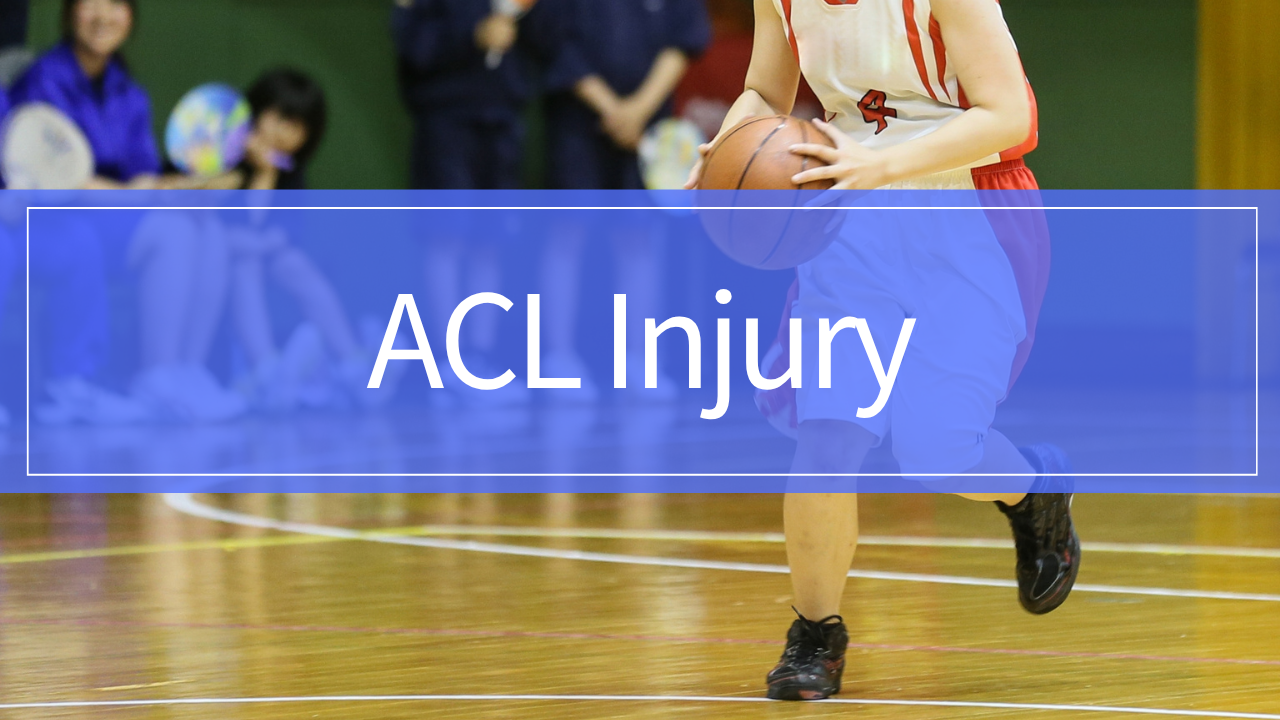
In this article, we will look at anterior cruciate ligament (ACL) injuries of the knee.
An ACL injury is one of the major knee injuries in sports that often requires a long period of rehabilitation before an athlete can return to sport.
Common symptoms immediately after the injury include knee swelling, difficulty activating the muscles around the knee, and a feeling that the knee is shifting or giving way. An ACL injury may also occur alongside damage to the meniscus or articular cartilage.
This article explains what to do after an ACL injury, how it is assessed at a medical facility, surgical and nonsurgical treatment options, rehabilitation, and general guidelines for returning to sport.
What You'll Learn in This Article
- What an anterior cruciate ligament (ACL) injury is
- Situations in which ACL injuries commonly occur
- Common symptoms after an ACL injury
- How an ACL injury is assessed and diagnosed
- How surgical and nonsurgical treatments are considered
- The stages of rehabilitation and guidelines for returning to sport
If you would like to learn more about knee pain in general, take a look at our related article on the knee joint.
What Is an Anterior Cruciate Ligament (ACL) Injury?
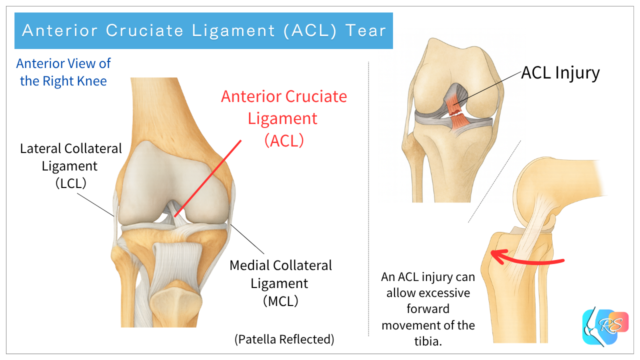
An ACL injury occurs when the anterior cruciate ligament (ACL) inside the knee is partially or completely torn (Figure 1).
The ACL connects the femur (thigh bone) to the tibia (shin bone). It is an important ligament that helps limit excessive forward movement of the tibia and control rotational movements of the knee.
When the ACL is injured, the knee may become unstable. Repeated episodes of the knee giving way can contribute to meniscal injuries or damage to the articular cartilage.
When an ACL injury is suspected, clinicians use a combination of medical history, physical examination, and imaging such as MRI. Common physical tests include the Lachman test and pivot shift test [1].

How Do ACL Injuries Commonly Happen?
ACL injuries can be classified as contact injuries, which occur when there is contact with another person, or noncontact injuries, which occur without direct contact.
Noncontact injuries may occur during jump landings, sudden changes of direction, or stopping movements, particularly when the knee moves inward.
If you remember your knee collapsing inward, hearing or feeling a pop, or feeling the knee shift during a landing or cutting movement, an ACL injury is a possibility.
Even if you can walk immediately after the injury, there may still be significant damage inside the knee. Avoid continuing practice based on your own judgment.
Common Symptoms After an ACL Injury
After an ACL injury, the knee may become significantly swollen within the first few hours, and it may be difficult to activate the muscles around the knee. Even if the pain improves over time, a feeling of the knee slipping or instability and giving way may persist during cutting movements or other sports activities.
- Significant knee swelling within a few hours of the injury
- Knee pain or difficulty bending and straightening the knee
- Difficulty activating the muscles around the knee or walking normally
- A feeling that the knee is shifting, slipping, or unstable
- Episodes of the knee giving way during changes of direction
In particular, if your knee swells rapidly after the injury, you cannot bend or straighten it, you have difficulty bearing weight, or you experience giving way or locking, consider seeing an orthopedic specialist promptly.
These symptoms are not unique to ACL injuries. Similar symptoms may occur with meniscal injuries, articular cartilage injuries, patellar dislocation, and medial collateral ligament (MCL) injuries. It is important not to diagnose the injury based on symptoms alone.

How Is an ACL Injury Diagnosed?
When an ACL injury is suspected, medical professionals assess it using a combination of medical history, palpation, physical tests, and imaging.
- Medical history: How the injury happened, whether the knee moved inward, whether there was a popping sound, and how quickly swelling developed
- Palpation and examination: Swelling, warmth, tenderness, and limitations in range of motion
- Physical tests: Lachman test, pivot shift test, and anterior drawer test
- MRI: Assessment of the ACL, menisci, bone bruising, and cartilage injuries
- X-rays: Assessment for fractures and avulsion fractures
In addition to physical tests, MRI is often used to assess the condition of the ACL, menisci, and bone bruising when diagnosing an ACL injury [1].

After an ACL Injury Diagnosis: Surgery or Nonsurgical Treatment?
Once an ACL injury has been diagnosed, the treatment plan generally involves considering either surgical treatment or nonsurgical treatment.
ACL reconstruction is often chosen by athletes who want to return to sports involving frequent jumping, cutting, and stopping movements.
However, nonsurgical treatment may also be considered depending on age, level of sport participation, knee instability, associated meniscal injuries, lifestyle, and return-to-sport goals [2].
Surgical Treatment
When surgery is selected, ACL reconstruction is commonly performed.
ACL reconstruction uses a tendon from the patient's own body to create a new ligament. Common options include a bone–patellar tendon–bone (BTB) graft using the patellar tendon and a hamstring tendon graft using the semitendinosus and gracilis tendons.
The most appropriate surgical technique depends on factors such as age, sport-specific demands, the condition of the knee, and the surgeon's approach.
- The athlete wants to return to a sport with frequent cutting or jumping movements
- The knee repeatedly gives way
- A meniscal injury is also present
- The knee has substantial instability
- The athlete competes at a high level and places a priority on reducing the risk of reinjury
Nonsurgical Treatment
Nonsurgical treatment aims to improve knee stability through rehabilitation without surgery.
It may be selected when the goal is to return to everyday activities, when a person plans to switch to activities with less cutting or jumping, or when the timing of surgery needs careful consideration in a growing athlete [2].
However, repeated episodes of giving way can increase the risk of damage to the menisci or cartilage, so the treatment plan should be decided in consultation with a physician.
- Avoid repeated episodes of the knee giving way
- Prevent further damage to the menisci and cartilage
- Do not make return-to-sport decisions on your own
- Assess strength, movement, and instability before returning to sport
Rehabilitation After ACL Reconstruction
Rehabilitation after ACL reconstruction progresses through several stages: managing swelling, restoring range of motion, rebuilding strength, preparing to run, developing jumping and cutting movements, and returning to sport.
A systematic review of return-to-sport rates reported that many athletes return to sport after ACL reconstruction, although not everyone returns to their preinjury level [3].
For this reason, return-to-sport decisions should consider more than time alone. Strength, movement quality, psychological readiness, and the presence or absence of pain and swelling are all important.
Early Postoperative Phase: Reduce Swelling and Pain, Restore Range of Motion
- Control swelling
- Restore the ability to fully straighten the knee
- Practice activating the quadriceps muscles
- Work toward walking normally without limping
- Maintain strength in other parts of the body
At this stage, it is more important to control swelling, regain knee extension, and restore quadriceps activation than to rush into more strength exercises.
For specific rehabilitation exercises, see the related article below.

1–2 Months After Surgery: Restore Range of Motion and Basic Strength
- Improve knee bending and straightening
- Begin weight-bearing exercises such as squats
- Strengthen the quadriceps, hamstrings, and gluteal muscles
- Improve stability during walking and stair climbing
Around 3 Months After Surgery: Prepare to Start Jogging
- Consider jogging with clearance from the physician and physical therapist
- Check that there is no knee pain or swelling
- Assess recovery of quadriceps strength
- Use movements such as single-leg squats to check whether the knee moves inward
4–6 Months After Surgery: Build Speed and Prepare for Agility Movements
- Work toward jogging comfortably for about 30 minutes
- Gradually increase running speed through acceleration runs
- Begin lateral movements and stepping drills at low intensity
- Assess jumping and landing mechanics
- Continue reducing strength differences between legs
6–12 Months After Surgery: Prepare to Return to Sport
- Gradually introduce full-speed running, jumping, and cutting movements
- Gradually add reactive drills and movements involving other players
- Progress from partial participation to full team training
- Assess strength in the quadriceps, hamstrings, and gluteal muscles
- Check for excessive inward knee movement
Return-to-sport assessments consider strength differences between legs, hop tests, jumping and landing mechanics, cutting movements, and psychological concerns. Comparing strength and function between the injured and uninjured legs is commonly included in return-to-sport criteria [4].
Young athletes who return to sport after ACL reconstruction have a reported risk of reinjuring the reconstructed ACL or injuring the ACL in the opposite knee. Research has shown high rates of secondary ACL injury among young athletes returning to sport [5].
Therefore, continue strength training, jump-landing exercises, cutting drills, and trunk and hip stability training even after returning to sport.
Rehabilitation With Nonsurgical Treatment
The basic principles of rehabilitation are similar whether an ACL injury is treated surgically or nonsurgically.
The key goals are to avoid episodes of the knee giving way, prevent persistent swelling, and gradually improve strength and movement quality.
- Control swelling
- Improve knee bending and straightening
- Strengthen the quadriceps and hamstrings
- Strengthen the gluteal and trunk muscles
- Perform squats, single-leg squats, and lunges
- Gradually introduce stepping drills and jumping movements
- Assess reactive movements and movements involving other players
With nonsurgical treatment, a person may be able to progress through rehabilitation stages more quickly if the knee is functioning well. However, if episodes of giving way occur, the treatment plan needs to be reconsidered.
Work with a physician or physical therapist as you progress, checking that swelling is absent, range of motion has recovered, strength has improved, and the knee does not give way.

When Can You Return to Sport?
Returning to sport after an ACL injury should not be based on the time elapsed alone. The condition of the knee, strength, movement quality, and psychological readiness all need to be considered.
What to Check Before Returning to Sport
- No knee swelling
- Little difference in knee bending and straightening between legs
- Adequate recovery of quadriceps and hamstring strength
- No excessive inward knee movement during single-leg squats
- Stable knee control during jump landings
- No giving way or feelings of instability during cutting movements
- No increase in pain or swelling after training or the following day
After ACL reconstruction, strength and hop tests are often used to assess differences between legs. A limb symmetry index (LSI) of at least 90%, comparing the injured and uninjured sides, may be used as one reference point [4].
However, a single number should not determine readiness to return to sport. Sport-specific movements, psychological concerns, and continued reinjury-prevention training also matter.
Frequently Asked Questions (FAQ)
Q1. Does every ACL injury require surgery?
No. Not everyone with an ACL injury needs surgery. Nonsurgical treatment may be an option for people aiming to return to everyday activities or sports with fewer cutting movements. However, surgery is often considered for athletes who want to return to sports involving frequent jumping and changes of direction [2].
Q2. If I can walk after the injury, does that mean my ACL is intact?
No. You may still have an ACL injury even if you can walk. If your knee becomes significantly swollen, feels as though it is shifting, or gives way, seek medical assessment even if the pain is mild.
Q3. Is an MRI always necessary?
When an ACL injury is suspected during an examination, MRI is often used to assess the ACL, menisci, bone bruising, and cartilage injuries. It can also provide important information when deciding on a treatment plan.
Q4. How many months does it take to return to sport?
The timeline depends on the surgical technique, sport, strength recovery, and movement quality. In general, a gradual return to sport may be considered over approximately 6–12 months, but the decision should also take strength, movement, swelling, and psychological concerns into account [3][4].
Q5. Can an ACL tear happen again after returning to sport?
Yes. Young athletes returning to sport are at risk of reinjuring the reconstructed ACL or injuring the ACL in the opposite knee [5]. Continuing strength training and movement training after returning to sport is important.
Summary
We have covered the symptoms, assessment, treatment options, rehabilitation, and return-to-sport considerations for anterior cruciate ligament (ACL) injuries.
- ACL injuries are significant knee injuries that commonly occur during jump landings and changes of direction.
- If your knee becomes significantly swollen after an injury, seek an orthopedic assessment promptly.
- Treatment decisions depend on sport participation, knee instability, associated injuries, and individual circumstances.
- Return-to-sport decisions should consider strength, movement quality, swelling, and psychological readiness—not time alone.
- Continuing reinjury-prevention training after returning to sport is important.
An ACL injury often requires a long rehabilitation period, but appropriate treatment and rehabilitation can help athletes work toward returning to sport.
If you have concerns, work with a sports orthopedic physician, physical therapist, or athletic trainer as you plan your recovery.