Ankle & Foot Pain: Common Causes and Key Conditions (Sorted by Location)


Ankle and foot pain can come from a sudden injury—like an ankle sprain—but it’s also common with repetitive sports loads from running, jumping, and cutting. Over time, those loads may contribute to stress fractures, tendon problems, and plantar (sole) irritation.
A practical way to narrow down the likely cause is to look at how the pain started (suddenly vs. gradually) and where it hurts (top of the foot, inside, outside, sole, heel, or the back of the ankle). This page lists common conditions by location so you can quickly find what fits your situation.
Safety note (YMYL): This article is for education and does not replace a medical evaluation. Seek urgent care if you have severe deformity, an open wound, rapidly increasing swelling, numbness/tingling, fever, you can’t bear weight, or pain that is severe even at rest. If symptoms don’t improve within a few days, consider seeing a qualified professional (sports medicine/orthopedics/physiotherapy) to rule out fractures or other significant injuries.

List of Conditions (Alphabetical)
- Accessory Navicular Syndrome (Painful Accessory Navicular)
- Achilles Tendinopathy
- Ankle Sprain (Inversion/Eversion)
- Anterior Ankle Impingement (Footballer’s/Soccer Player’s Ankle)
- Calcaneal Apophysitis (Sever’s Disease)
- Freiberg Infraction (Freiberg Disease)
- Flexor Hallucis Longus (FHL) Tendinopathy
- Hallux Valgus (Bunion)
- Heel Fat Pad Pain (Heel Fat Pad Syndrome)
- Jones Fracture (5th Metatarsal Base Stress Fracture)
- Lisfranc Sprain (Tarsometatarsal Joint Injury)
- Medial Malleolus Stress Fracture
- Morton’s Neuroma
- Navicular Stress Fracture
- Os Trigonum Syndrome (Posterior Ankle Impingement)
- Peroneal Tendon Injury (Tendinopathy / Subluxation)
- Plantar Fasciitis
- Posterior Tibial Tendon Dysfunction (PTTD) / Posterior Tibial Tendinopathy
- Second–Fourth Metatarsal Stress Fractures
- Sesamoiditis (Big-Toe Sesamoid Injury)

Wow—there are so many possible causes of foot pain… 😥
Acute Injuries
—Pain that started suddenly
This section covers ankle & foot pain that began at a clear moment—such as twisting the ankle, landing awkwardly, or feeling a sharp pain during one specific movement.
If you twisted your foot/ankle
- Ankle Sprain (Inversion/Eversion)
The most common sports injury in this region—especially lateral (outer) ligament sprains. Good early care and a complete rehab plan help reduce the risk of ongoing pain and chronic ankle instability. - Peroneal Tendon Injury (Tendinopathy / Subluxation)
Irritation or instability of the peroneal tendons that run behind the outer ankle bone. If the tendon repeatedly “snaps” or slips out of place, specialist assessment is important and surgery may be discussed in some cases. - Lisfranc Sprain (Midfoot Injury)
Injury to the Lisfranc (tarsometatarsal) joint complex in the midfoot. Weight-bearing is often difficult. Because missed injuries can lead to long-term instability, early evaluation matters.

If you hit your heel hard
- Heel Fat Pad Pain (Heel Fat Pad Syndrome)
The heel’s natural cushioning tissue becomes irritated after impact. Pain is often strongest directly under the heel, especially when you first put the heel on the ground.
Chronic Overuse Injuries
—Pain that built up gradually
Gradual-onset pain is often easier to understand when it’s grouped by location: the top/front of the foot, the inside (medial), the outside (lateral), the sole, or the back of the ankle.
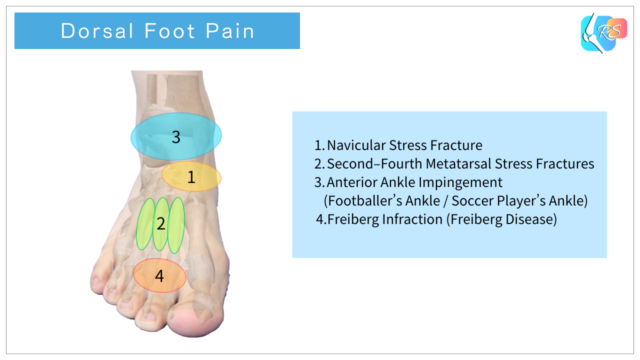
Top of foot pain (dorsal/front)
- 1) Navicular Stress Fracture
A stress fracture in the navicular bone (midfoot). Because blood supply can be limited, healing may be slow—early diagnosis helps prevent prolonged symptoms. - 2) Second–Fourth Metatarsal Stress Fractures
Caused by repeated stress to the metatarsals. The 2nd and 3rd are common, and pain on the top of the foot may appear after starting or increasing running volume. - 3) Anterior Ankle Impingement (Footballer’s/Soccer Player’s Ankle)
Front-of-ankle pain and a “pinching” or “blocked” feeling when the ankle bends upward (dorsiflexion). Bony spurs or soft-tissue thickening may contribute. - 4) Freiberg Infraction (Freiberg Disease)
A condition affecting the metatarsal head (often the 2nd), more common in adolescents. It can cause forefoot pain during weight-bearing.
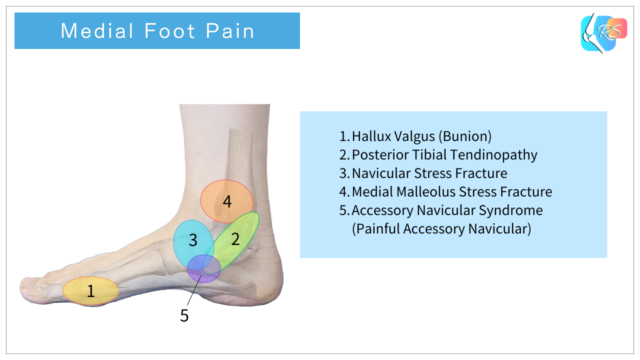
Inner foot pain (medial)
- 1) Hallux Valgus (Bunion)
A toe deformity where the big toe drifts toward the smaller toes. The bump can become inflamed and painful, and walking pain may worsen as it progresses. - 2) Posterior Tibial Tendon Dysfunction (PTTD) / Posterior Tibial Tendinopathy
Irritation of the posterior tibial tendon below the inner ankle bone. It often relates to a flatter arch; in some cases, symptoms progress with increasing arch collapse. - 3) Navicular Stress Fracture
A midfoot stress fracture that can present as inner-foot pain. Limited blood supply can delay healing, so early diagnosis is important. - 4) Medial Malleolus Stress Fracture
A stress fracture on the inner ankle bone. It can occur in jumping and cutting sports and may be slow to heal if loading continues. - 5) Accessory Navicular Syndrome
Inflammation around an accessory navicular bone on the inner side of the foot. It’s common in growing athletes and can be aggravated by traction from the posterior tibial tendon.
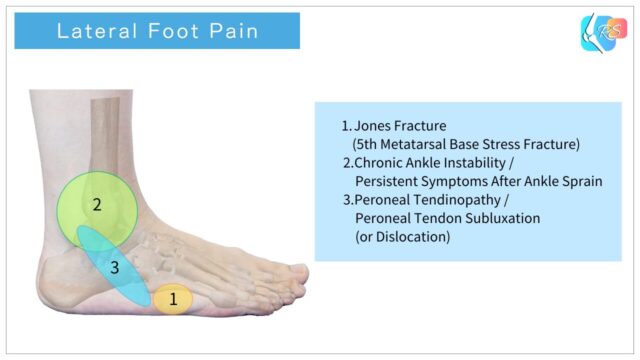
Outer foot pain (lateral)
- 1) Jones Fracture (5th Metatarsal Base Stress Fracture)
A fracture at the base of the 5th metatarsal. Because blood supply can be limited, healing may be slow; in competitive athletes, surgery may sometimes be considered. - 2) Ongoing Pain After an Ankle Sprain
If outer-ankle pain or “giving way” continues after a sprain, common contributors include incomplete rehab, chronic ankle instability, impingement, or tendon irritation. A clinical assessment helps clarify the cause. - 3) Peroneal Tendon Injury (Tendinopathy / Subluxation)
Inflammation or partial instability of the peroneal tendons. Swelling behind the outer ankle and a sense of snapping or giving way may occur.
Sole pain (bottom of the foot / plantar)
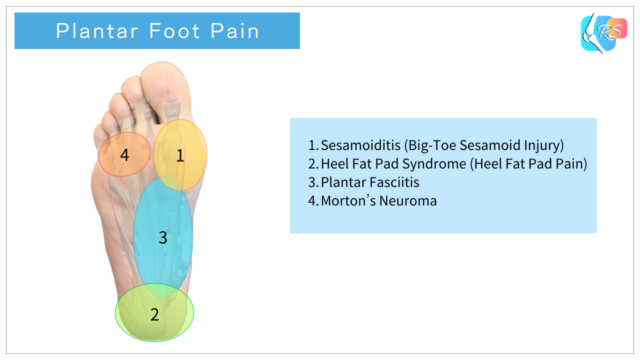
- 1) Sesamoiditis (Big-Toe Sesamoid Injury)
Irritation of the sesamoid bones under the big toe. Pain is often sharp with push-off, jumping, or loading through the ball of the big toe. - 2) Heel Fat Pad Pain (Heel Fat Pad Syndrome)
Often feels like pain directly under the heel, especially with impact or hard surfaces. Pressing the center of the heel may be tender. - 3) Plantar Fasciitis
Irritation near the plantar fascia attachment. A classic symptom is heel pain with the first steps in the morning or after sitting. - 4) Morton’s Neuroma
Irritation/entrapment of an interdigital nerve—often between the 3rd and 4th toes—causing burning, tingling, numbness, or electric shock-like pain.
Back of ankle pain (posterior ankle/heel)
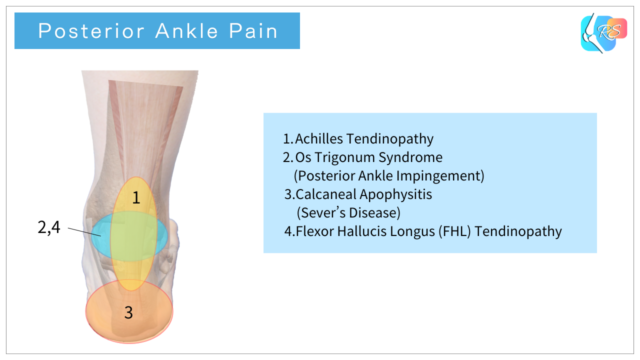
- 1) Achilles Tendinopathy
Overuse-related irritation and degeneration of the Achilles tendon. Pain is common at the start of running or after exercise; chronic cases may show tendon thickening. - 2) Os Trigonum Syndrome (Posterior Ankle Impingement)
Pain at the back of the ankle, often worse with plantarflexion (pointing the toes). It’s common in ballet and soccer due to posterior impingement. - 3) Calcaneal Apophysitis (Sever’s Disease)
A growth-related heel condition in children and adolescents. Repeated traction from the Achilles tendon can cause pain at the heel growth plate. - 4) Flexor Hallucis Longus (FHL) Tendinopathy
Irritation of the FHL tendon. Symptoms can resemble os trigonum syndrome, and pain often increases with plantarflexion.
Summary
We organized common causes of ankle and foot pain by onset (sudden vs. gradual) and location (top, inner, outer, sole, heel, and back of the ankle).
If you spot a likely match, use it as a starting point—and consider a professional evaluation when symptoms are severe, persistent, or limiting your activity. We’ll also add more detailed pages for each condition to explain typical symptoms, contributing factors, and general recovery considerations.