LCL Injury: Symptoms, Treatment & Return to Sport

After a blow to the inside of the knee during sports such as rugby or soccer, symptoms like “pain on the outside of the knee” or “the knee feels unstable when changing direction” may be related to a lateral collateral ligament (LCL) injury.
An LCL injury can occur on its own, but it may also be accompanied by a posterior cruciate ligament (PCL) injury or an injury to the posterolateral corner (PLC) of the knee. This is why it is important to assess not only where the pain occurs but also whether the knee is unstable or other structures have been injured.
This article explains the symptoms of an LCL injury, when to seek medical attention, how the injury is assessed and treated, and how rehabilitation and return to sport are approached.
- Where the LCL is located and how it can be injured
- Symptoms of pain on the outside of the knee and when to seek medical attention
- How nonoperative and surgical treatment are considered
- How rehabilitation and return to sport are progressed
For a broader overview of knee pain, you may also find the following article helpful.
What Is a Lateral Collateral Ligament (LCL) Injury?
A lateral collateral ligament (LCL) injury involves partial or complete damage to the lateral collateral ligament (LCL) on the outside of the knee.
The LCL runs from the outer side of the femur (thighbone) to the head of the fibula. It helps stabilize the knee against varus stress, a force that tends to open the outer side of the knee joint (Figure 1).
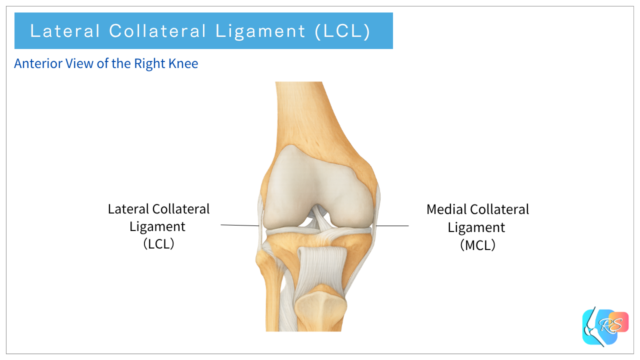
The LCL is one of the major structures contributing to stability at the posterolateral corner (PLC) of the knee. In addition to the LCL, the PLC includes structures such as the popliteus tendon and popliteofibular ligament. Together, these structures help resist varus and external rotational forces at the knee [1].

LCL injuries can occur in rugby, soccer, American football, combat sports, skiing, and other activities when a strong varus or twisting force is applied to the knee.
- Taking a tackle or direct blow to the inside of the knee
- Having the knee pushed outward during contact with another player
- Falling with a combination of varus and twisting forces at the knee
- Twisting the knee while the foot remains fixed, as can happen in skiing

More forceful injuries may also involve the anterior cruciate ligament (ACL) or posterior cruciate ligament (PCL).
Common Symptoms of an LCL Injury and When to Seek Medical Attention
Pain and tenderness on the outside of the knee are common symptoms of an LCL injury(Figure2).
Pain or a feeling of instability may occur when walking, pushing off on one leg, changing direction, or taking part in contact activities.
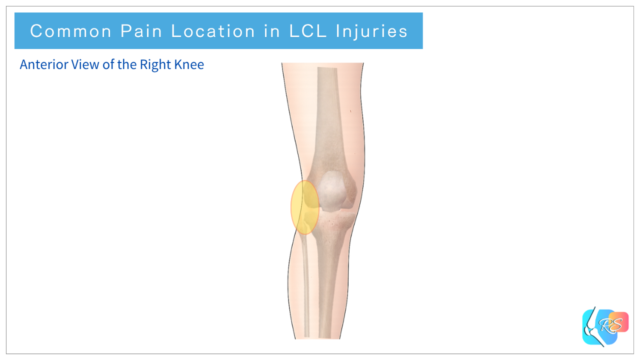
- Pain or tenderness on the outside of the knee or around the fibular head
- Pain on the outside of the knee when walking or climbing stairs
- Pain when pushing off on one leg or changing direction
- A feeling that the knee is unstable, gives way, or shifts outward
- Pain when bending or straightening the knee, particularly with more severe injuries
However, pain on the outside of the knee does not necessarily mean the LCL is injured. A lateral meniscus injury, iliotibial band syndrome, injury around the popliteus, or PLC injury can cause symptoms in a similar area. If the knee catches after an injury, a meniscus injury and other possible causes should also be assessed.
If pain or instability persists after contact or a fall, consider seeing an orthopedic specialist for an assessment rather than applying varus stress to your own knee to test it.
- Severe pain that makes it difficult to bear weight or walk
- Marked swelling or an obvious deformity of the knee
- Significant instability or a feeling that the knee is giving way
- Difficulty lifting the ankle or toes, or numbness over the top of the foot
- A cold foot, abnormal skin color, or other signs of possible impaired blood flow
The common peroneal nerve runs near the LCL and PLC. A more severe injury in this area may therefore cause difficulty lifting the ankle or numbness over the top of the foot. With multiligament knee injuries caused by substantial force, assessment of the nerves and blood vessels is also important [2].
How Is an LCL Injury Diagnosed?
A healthcare professional will ask how the injury occurred and assess the location of pain, swelling, knee range of motion, instability, and any neurological symptoms.
- Palpation and range of motion: Checking for tenderness around the LCL and assessing knee bending and straightening.
- Varus stress test: Assessing laxity when a force is applied that tends to open the outside of the knee.
- Rotational instability tests: Tests such as the dial test may be performed when a PLC injury is suspected.
- Neurological assessment: Checking ankle movement strength and sensation over the top of the foot.
- Imaging: X-rays, MRI, or stress radiographs may be used as needed.
MRI can be used to assess not only the LCL but also the ACL, PCL, meniscus, and structures of the PLC. However, studies have reported that the apparent severity of an LCL injury on imaging does not always match the instability found during a clinical examination. Treatment decisions should therefore be based on both the imaging findings and the clinical assessment [2][3].
Treatment Options for an LCL Injury
Treatment for an LCL injury generally falls into nonoperative treatment and surgical treatment. The choice is not based solely on the injury grade or whether the LCL appears torn on MRI. It also depends on whether the LCL is injured in isolation, the degree of varus and rotational instability, and whether the PLC, ACL, PCL, or other structures are involved.
Mild to moderate isolated LCL injuries identified on clinical assessment are often managed by temporarily modifying activity, using a brace when appropriate, and progressing through rehabilitation. In a 2025 case series of 55 elite athletes, all isolated LCL injuries without rotational instability were managed nonoperatively, and the athletes returned to sport [3].
On the other hand, surgery may be considered when a more extensive PLC injury causes clear varus and rotational instability, or when several knee ligaments are injured. A 2025 international consensus statement recommends reconstruction for complete grade III PLC injuries [2].
There are also reports of athletes returning to sport after nonoperative management of isolated grade III LCL injuries. However, this evidence includes individual case reports, so treatment for severe injuries needs to be determined on a case-by-case basis [4].
Rehabilitation After an LCL Injury
Rehabilitation after an LCL injury should progress according to more than just the number of weeks since the injury. Pain, swelling, instability, walking ability, strength, single-leg movement, and the knee's response to sport-specific activities should all be considered when gradually increasing the load.
The following approach mainly applies to isolated LCL injuries managed nonoperatively. Progression will vary depending on injury severity, brace use, and any associated injuries.
Rehabilitation With Nonoperative Treatment
1. Protect the LCL While Allowing Pain and Swelling to Settle
Immediately after the injury, avoid strong varus forces that tend to open the outside of the knee. Crutches may be used when pain is severe, and a brace may be recommended if the knee is unstable.
- Keep daily activities within a range that does not worsen pain or swelling
- Use a brace or crutches if needed
- Maintain knee bending and straightening within the permitted range
- Maintain muscle activation, including the quadriceps
2. Restore Range of Motion and Basic Strength
As pain and swelling settle, work on restoring knee bending and straightening while rebuilding strength in the quadriceps, gluteal muscles, and trunk. During walking, also check whether you are leaning excessively from side to side to avoid pain or whether the knee feels unstable.
3. Progress to Weight-Bearing Strength Exercises and Single-Leg Movements
Once walking is stable and exercise does not cause a substantial increase in symptoms afterward, squats, lunges, and single-leg stance exercises can be introduced as appropriate. Along with muscle strength, the ability to keep the knee stable while supporting your body weight on one leg is important.
- Pain on the outside of the knee is not severe during exercise
- Swelling does not increase after exercise
- There is no marked instability during walking or single-leg movements
- Symptoms do not clearly worsen later that day or the following day
4. Progress From Running to Changes of Direction and Sport-Specific Movements
Once sufficient range of motion and strength have returned and single-leg movements are stable, begin with straight-line running and gradually increase speed. Then progress step by step to jumping and landing, deceleration, changes of direction, and cutting movements.
In sports such as rugby and soccer, the final stages involve returning to training that includes contact with opponents and unpredictable movements. It is important to assess not just whether an activity can be completed once, but also whether pain, swelling, or instability worsen as training volume increases.
Rehabilitation After Surgery
Rehabilitation after surgery for a PLC injury or multiligament knee injury differs from nonoperative rehabilitation. The use of a brace and the timing of weight-bearing, range-of-motion exercises, and strengthening depend on the surgical procedure and the structures repaired or reconstructed [2].
For this reason, after surgery, avoid increasing the load on your own based only on a general timeline. Rehabilitation should follow the protocol provided by the surgeon and treating physician.
Key Points for Returning to Sport After an LCL Injury
When returning to sport after an LCL injury, it is important to assess how well you can perform the movements your sport requires, rather than relying only on how many weeks have passed. There are no widely established, standardized return-to-sport criteria specific to LCL injuries, so decisions should take injury severity and the demands of the sport into account.
- Pain and swelling on the outside of the knee have settled during daily activities and running
- Knee range of motion has recovered sufficiently, without marked varus or rotational instability
- Strength and single-leg movement have recovered, and jumping, landing, and deceleration can be performed with control
- Changes of direction, cutting, and contact activities when required can be reintroduced gradually
- Pain, swelling, and instability do not worsen after training or the following day
In a 2025 case series involving elite athletes, the median time to return to sport after isolated LCL injuries without rotational instability was 76 days [3]. However, the study involved athletes at a specific competitive level. It does not mean that everyone with an LCL injury can return to sport in approximately two to three months.


Summary
- With an LCL injury, it is important to assess knee instability and associated injuries, not just pain on the outside of the knee.
- Numbness in the foot, muscle weakness, or signs of impaired blood flow require prompt medical assessment.
- Treatment can differ substantially between an isolated LCL injury and a more extensive injury involving the PLC.
- Rehabilitation and return to sport should be guided by knee function and the response to activity afterward and the following day, not by time alone.