Low Back Pain: Definition, Red Flags, and Common Causes


What Is Low Back Pain?
Low back pain refers to pain or discomfort felt in the area from the bottom of the ribs down to the top of the buttocks.
It is extremely common in everyday life and in sports, and it is also one of the most frequent reasons people visit orthopedic clinics.
It’s important to remember that low back pain is not a “diagnosis”—it is a symptom.
In other words, the cause could be:
• a muscle problem
• a joint problem
• a disc problem
• a nerve problem
or even pain referred from internal organs
Depending on the cause, the best approach can look very different.
That’s why organizing “what might be involved” is the first step toward improving low back pain.

Dangerous Low Back Pain (Red Flags)
Most cases of low back pain are not life-threatening.
However, in rare cases, a serious condition may be present. These warning signs are often called “red flags.”
If you notice any of the symptoms below, consider getting medical evaluation early.
Severe pain that persists even at rest, worsening night pain, fever, unexplained weight loss, a history of cancer, numbness or weakness in both legs, changes in bladder or bowel control, severe pain after major trauma (such as a fall), low back/flank pain with blood in the urine.
These signs can suggest conditions such as infection, tumor, compression fracture, internal organ injury, or cauda equina syndrome.
If your back pain feels “different than usual” or clearly unusual, it’s best not to self-diagnose.

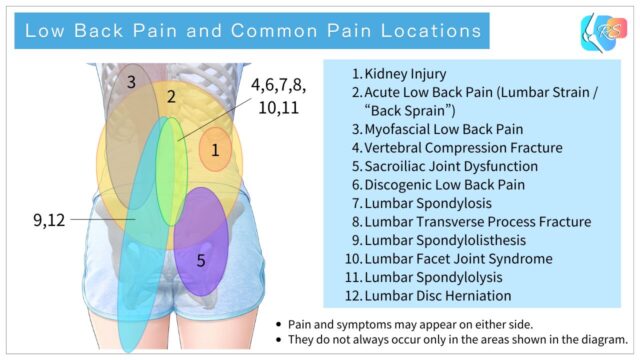
List of Conditions (A–Z)
- Kidney injury
- Acute low back pain (“back strain” / sudden onset)
- Myofascial low back pain
- Vertebral compression fracture
- Sacroiliac joint dysfunction
- Discogenic low back pain
- Lumbar spondylosis (degenerative changes)
- Lumbar transverse process fracture
- Lumbar spondylolisthesis
- Lumbar facet joint disorder
- Lumbar spondylolysis
- Lumbar disc herniation
*This overview also includes low back pain that can originate from internal organs.
How Low Back Pain Is Classified
In rehabilitation, the best plan depends on which tissues are driving the pain.
That’s why it helps to classify low back pain by pain type.
Here is a simplified classification (more than one category can overlap).
Common features include numbness/tingling and pain that may persist even at rest.
Pain that appears when certain muscles are overloaded—often with poor posture, forceful effort, or fatigue.
Pain triggered by spinal movement such as bending, extending, or rotation.
Includes fractures after falls and stress injuries such as lumbar spondylolysis in growing athletes.
With low back pain, the painful spot doesn’t always match the injured tissue, and imaging findings don’t always explain symptoms.
That’s why it helps to consider the time course, pain quality, how it started, and whether there are nerve symptoms.
What is non-specific low back pain?
“Specific” low back pain means the cause can be identified through medical evaluation and imaging (such as X-ray or MRI). “Non-specific” low back pain refers to cases where a clear structural cause cannot be determined.Reference: Low back pain prevention guidance (public health resource)
Acute Injuries
– Sudden Onset of Pain
This section summarizes low back pain cases where you can clearly identify the moment the pain began.
Pain When Moving the Lower Back
- Acute low back pain (“back strain”)
Pain can appear suddenly—often when lifting or twisting. Many cases improve over several days to a few weeks, but evaluation is important if nerve symptoms are present. - Lumbar disc herniation
A bulging or herniated disc can irritate a nerve root. Along with back pain, leg pain, numbness, or radiating symptoms may occur. - Myofascial low back pain
Pain caused by overload of the lumbar muscles and fascia. Poor posture, repetitive movement, and accumulated fatigue are common contributors. - Discogenic low back pain
Pain linked to disc degeneration or small disc injuries. Symptoms often worsen with forward bending. - Lumbar facet joint disorder
Pain from overload of the facet joints. Symptoms often worsen with back extension or rotation. - Sacroiliac joint dysfunction
Pain related to the sacroiliac joint in the pelvis. It often presents as one-sided buttock pain.
After a Fall or Direct Impact
- Lumbar transverse process fracture
A fracture of the bony “side projection” of a lumbar vertebra after trauma. Many cases improve with conservative care. - Kidney injury
After significant trauma, flank/low back pain may occur. Blood in the urine or nausea can appear, and urgent evaluation may be needed. - Vertebral compression fracture
A fracture that can occur after a fall, especially in people with osteoporosis. Early diagnosis matters when pain is strong.
Chronic Conditions
– Gradual Onset of Pain
- Lumbar disc herniation
Back pain with leg symptoms such as pain, numbness, or altered sensation. - Lumbar spondylolysis
A stress fracture in the lumbar spine, common in growing athletes. Early detection improves outcomes. - Myofascial low back pain
Pain due to overload of lumbar muscles and fascia, often linked to posture, repetitive work, or training load. - Discogenic low back pain
Pain related to disc changes; forward bending may aggravate symptoms. - Lumbar facet joint disorder
Pain related to the facet joints; extension/rotation can be provocative. - Sacroiliac joint dysfunction
Often presents as one-sided buttock pain and can be triggered by load transfer through the pelvis. - Lumbar spondylosis
Low back pain associated with age-related degenerative changes in discs and joints. - Lumbar spondylolisthesis
A vertebra shifts forward, which can stress joints and nerves. Back pain and sometimes leg symptoms may occur.
Summary
We organized low back pain into practical categories: what low back pain means, red flags that warrant early medical evaluation, and common conditions that can cause sudden or gradual symptoms.
Next, we’ll explain each condition in more detail, including typical symptoms and rehabilitation considerations.